Hello! I’m Danny, a professional Korean instructor at Podo Korean. Have you ever felt embarrassed while studying Korean because you directly translated English words into Korean?
While conducting a Korean lesson with an American student today, I stumbled upon a very interesting and fun topic. As soon as the lesson started, the student on my screen greeted me brightly.
오늘 새로운 안경을 입었어요.
(I wear new glasses today.)
I couldn’t help but smile upon hearing the student. It was a very natural and cute mistake that occurred because in English, the verb ‘to wear’ is used for everything you put on your body.
For English-speaking learners, the Korean verb for ‘to wear’ is one of the most confusing topics. While English uses ‘wear’ for everything from hats to pants to shoes, Korean clothing verbs change completely depending on which part of the body you are wearing the item on.
So today, to ensure you no longer make mistakes like ‘안경을 입다’ (wear glasses), I will perfectly organize the various Korean clothing verbs that change based on body parts. By reading this post to the end, you will be able to choose the natural words like a native Korean speaker.
1. The Basic Korean clothing Verbs: 입다
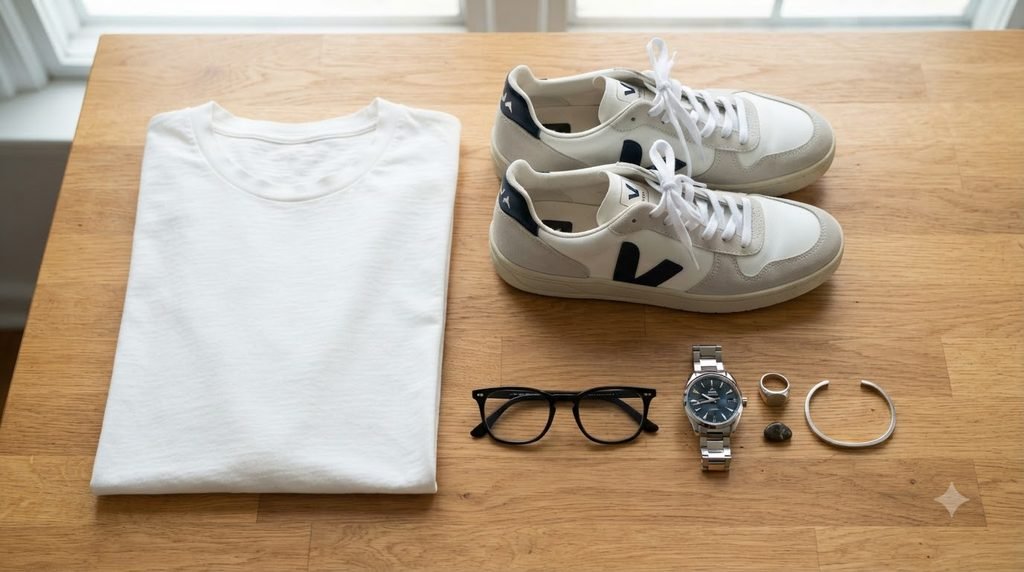
The most basic and widely used Korean clothing verb is ‘입다’ (ib-da). This word is used when wearing clothes on the widest parts of our body: the upper and lower body.
You should use ‘입다’ for any clothing that covers the torso, ranging from tops like t-shirts, sweaters, shirts, jackets, and coats, to bottoms like pants and skirts, and even full-body items like dresses and suits. If you look up a Korean basic dictionary, it clearly defines the act as draping or wrapping clothing around the body.
Furthermore, traditional Korean clothing (Hanbok), as well as swimsuits, pajamas, and school uniforms used in special situations, all use ‘입다’ without exception. If it’s something made of fabric that you drape over your body, think of this word.
오늘 날씨가 너무 추우니까 패딩을 입고 나가세요.
(The weather is really cold today, so make sure to wear a padded jacket when you go out.)저는 집에서 쉴 때 편한 티셔츠를 입는 것을 좋아해요.
(I like to wear a comfortable t-shirt when resting at home.)어제 백화점에서 산 예쁜 원피스를 입어봤어요.
(I tried on the pretty dress I bought at the department store yesterday.)
2. For Head and Face Accessories: 쓰다
This is the very word my student made a mistake with. In Korean, when you wear something on your head or face, you must use the verb ‘쓰다’ (sseu-da) instead of ‘입다’. It is easy to understand if you imagine the physical action of covering something from top to bottom.
Items that protect or decorate the head, such as baseball caps, beanies, and helmets, all combine with ‘쓰다’. Additionally, items worn on the face—such as glasses, sunglasses, masks, and eye patches—also use this verb.
Interestingly, even an ‘umbrella,’ which you unfold and hold over your head to avoid rain (without wearing it on your body), uses ‘쓰다’. Remember, you don’t say ‘우산을 입다’ or ‘우산을 하다’.
햇빛이 너무 강해서 선글라스를 쓰지 않으면 눈이 아파요.
(The sunlight is so strong that my eyes hurt if I don’t wear sunglasses.)도서관에서 공부할 때는 항상 모자를 쓰고 가요.
(When I study at the library, I always wear a hat.)밖에 비가 많이 오고 있으니까 우산을 쓰고 나가야 해요.
(It’s raining a lot outside, so you have to use an umbrella when you go out.)
3. For Protecting Feet: 신다
Now that we’ve covered the body and head, let’s move down to the feet. For all types of items worn on the feet, we use the verb ‘신다’ (sin-da). It is a very important word that is clearly distinct from ‘입다’ (used for clothes).
Korea traditionally has a floor-sitting culture where people take off their shoes when entering a house. Therefore, phrases like ‘신발을 벗다’ (take off shoes) and ‘신발을 신다’ (put on shoes) appear multiple times a day in the daily lives of Koreans.
Not only footwear like sneakers, dress shoes, boots, sandals, and slippers, but also socks and stockings worn on the feet use ‘신다’. It describes the action of inserting something onto the specific body part that is the foot.
한국에서는 집 안에 들어갈 때 반드시 신발을 벗고 실내화를 신어야 합니다.
(In Korea, you must take off your shoes and wear indoor slippers when entering a house.)오늘 등산을 가기로 했으니까 발이 편한 등산화를 신는 것이 좋겠어요.
(Since we decided to go hiking today, it would be good to wear comfortable hiking boots.)구두를 신기 전에는 꼭 양말이나 스타킹을 먼저 신으세요.
(Before wearing dress shoes, make sure to wear socks or stockings first.)
4. For Small Accessories: 차다 and 끼다
When I explained the differences between ‘쓰다’, ‘입다’, and ‘신다’ during class, my student, who was usually interested in fashion, asked with sparkling eyes, “Teacher, then how do you express wearing a watch or a ring?”
It was an excellent question. Small and delicate accessories are divided into two verbs, ‘차다’ (cha-da) and ‘끼다’ (kki-da), depending on the method and part of the body used. First, ‘차다’ is used for items that wrap around and secure to round parts of the body, like the wrist or waist. Representative examples include wristwatches, bracelets, and belts.
On the other hand, ‘끼다’ means the action of pushing something into a narrow gap or space to secure it. This applies to rings that fit onto fingers, gloves that cover the entire hand, and contact lenses that are placed and fixed on the pupils.
저는 매일 아침 출근하기 전에 항상 스마트워치를 찹니다.
(I always wear a smartwatch every morning before going to work.)결혼기념일이라서 남편과 함께 맞춘 커플 반지를 꼈어요.
(Because it’s our wedding anniversary, I wore the couple ring I got with my husband.)겨울에는 밖에 나갈 때 꼭 두꺼운 장갑을 껴야 해요.
(I must wear thick gloves in winter when going outside.)
5. Other Useful Verbs: 메다, 매다, 하다
It doesn’t end there. Korean expressive power is truly limitless. I will additionally introduce three expressions that Koreans use very often in daily life, but foreigners find particularly difficult.
First, when putting a bag on your shoulder, use ‘메다’ (me-da). It describes the action of placing a backpack, eco-bag, or shoulder bag on your shoulder.
Second, when performing an action of tying a knot, like with a necktie or shoelaces, use ‘매다’ (mae-da), which sounds similar but has a different meaning.
Third, for accessories like necklaces, earrings, and scarves, ‘하다’ (ha-da) is used as a universal verb. Of course, you can express wearing a scarf as ‘두르다’, but in daily conversation, saying ‘목도리를 하다’ is much more natural.
노트북이 너무 무거워서 오늘은 백팩을 메고 회사에 왔어요.
(My laptop is too heavy, so I wore a backpack to work today.)중요한 회의가 있는 날에는 항상 파란색 넥타이를 맵니다.
(On days with important meetings, I always wear a blue tie.)어제 친구가 생일 선물로 예쁜 귀걸이를 사줘서 바로 해 봤어요.
(My friend bought me pretty earrings for my birthday yesterday, so I wore them right away.)
6. Learning Korean Through Situations
As we have explored so far, there are truly various ways to say ‘to wear’ in Korean. I never recommend the method of just writing ‘wear = 입다, 쓰다, 신다, 차다, 끼다’ in an English vocabulary notebook and memorizing them blindly.
If you develop a habit of 1-to-1 translation into your mother tongue while learning Korean, you are highly likely to repeat awkward mistakes like “안경을 입다” because you get stuck in the translation process in your head. Language is not a math formula, but an organism embedded with culture and situations.
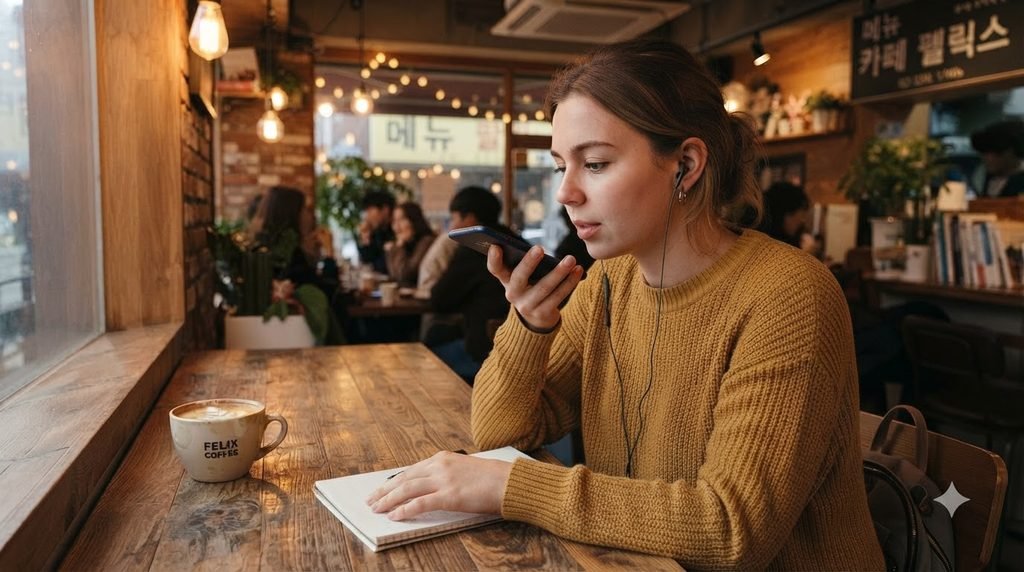
Therefore, it is essential to learn sentences as whole chunks within context and situations, and train by speaking them directly to build muscle memory. You must move beyond just visual learning and actually practice saying them out loud to avoid panic in real-life situations.
If you are lost on how to practice speaking alone, I highly recommend using the Podo Speak app. This app doesn’t just list words; it provides natural expressions that real Koreans use every day, categorized by situation.
In Podo Speak, you can listen to diverse example sentences for expressions like “모자를 쓰다” and “반지를 끼다”, and practice shadowing them yourself. Since I, a native teacher, have carefully vetted every sentence, you can trust and learn 100% natural Korean without any awkward machine-translated sentences.
Conclusion
Making mistakes in the process of learning a language is very natural and beautiful. Thanks to my American student asking, we had a fun lesson, and I was able to share useful information with you.
Don’t be afraid of mistakes. However, if you want to reduce the same errors and speak more natural Korean, please practice the expressions we learned today in sentence units. Keep doing so until your lips react before your brain does.
If you want to practice more diverse and practical Korean conversational expressions like a native, download Podo Speak right now and build the habit of speaking out loud for 10 minutes every day. Danny, your professional Podo Korean teacher, will always sincerely support your Korean language learning journey. Thank you!