Hello! This is Danny, your dedicated Korean teacher from Podo Korean, here to guide you on your language learning journey. Today, we’re tackling a topic that’s surprisingly tricky, not just for learners, but for native Koreans as well. The confusion between ‘wrong vs different in Korean’—specifically, the words ‘틀리다 (tteullida)’ and ‘다르다 (dareuda)’—is one of the most common mistakes you’ll hear. While most Koreans might overlook this slip-up in daily conversation, as a teacher, I can’t help but cringe a little whenever I hear it on TV or YouTube. You could call it an occupational hazard! 🙂
By the end of this post, you’ll have a crystal-clear understanding of these two words. Not only will you use them correctly, but you’ll also be able to gently correct your Korean friends, adding a fun new dimension to your language practice. Ready to dive in and master this crucial distinction?
‘틀리다 (Tteullida)’: When Something is Factually Incorrect
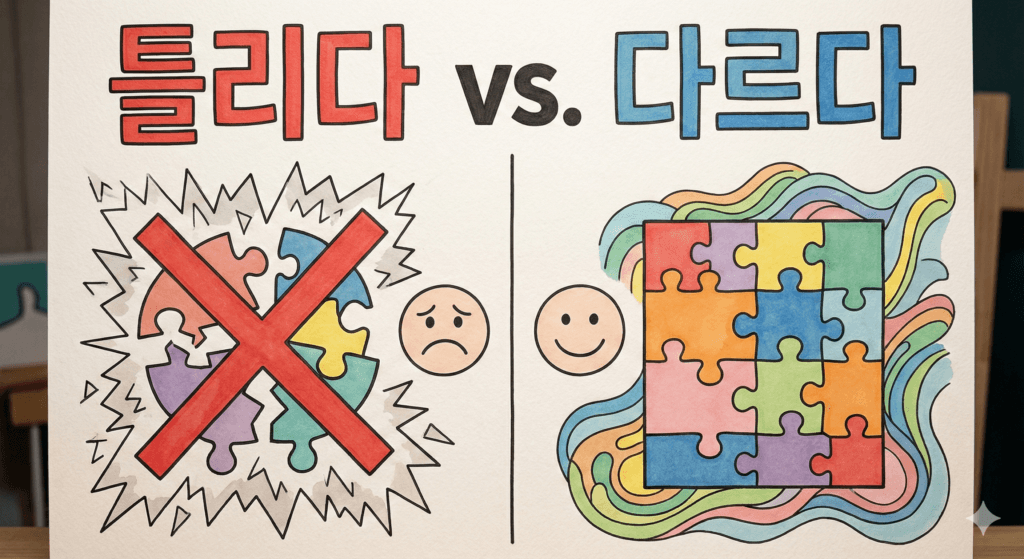
First, let’s break down ‘틀리다 (tteullida)’. The core meaning of this verb is ‘to be wrong’ or ‘to be incorrect.’ You use ‘틀리다’ when there is a clear, objective standard, fact, or rule, and something deviates from it. Think of situations where there’s a definitive ‘right’ and ‘wrong’ answer. It’s about factual accuracy, not personal opinion.
Imagine a math problem. ‘1 + 1 = 2’ is the correct answer. If someone writes ‘1 + 1 = 3,’ you can confidently say, “그 답은 틀렸어요 (geu dabeun teullyeosseoyo),” which means “That answer is wrong.” Why? Because there’s a universally accepted correct answer. The concept of wrong vs different in Korean starts here: ‘틀리다’ belongs to the realm of facts and rules.
Let’s explore more examples to see ‘틀리다’ in action:
- For Factual Errors: Imagine someone says, “한국의 수도는 부산이다.” (The capital of Korea is Busan.) This is factually incorrect. You would correct them by saying, “그 정보는 틀렸어요. 한국의 수도는 서울이에요.” (That information is wrong. The capital of Korea is Seoul.)
- For Calculation Mistakes: You buy something at a store and get your change, but the amount seems off. You could say, “사장님, 거스름돈 계산이 틀린 것 같아요. 다시 확인해 주세요.” (Sir/Ma’am, I think the change calculation is wrong. Please check it again.)
- For Spelling or Grammar Errors: A common situation for language learners! If you write ‘김치찌게’ instead of the correct ‘김치찌개’ (Kimchi Jjigae), a teacher would say, “‘김치찌게’는 틀린 표기법이에요. ‘김치찌개’가 맞아요.” (‘김치찌게’ is the wrong spelling. ‘김치찌개’ is correct.)
- For Breaking Rules: Cheating on an exam is against the rules. You could state, “시험 중에 다른 사람의 답을 보는 것은 틀린 행동입니다.” (Looking at someone else’s answer during a test is the wrong thing to do.)
Since ‘틀리다’ is a verb, it conjugates based on tense: ‘틀려요’ (present), ‘틀렸어요’ (past), and ‘틀릴 거예요’ (future). The key takeaway is to always associate ‘틀리다’ with an objective standard and the existence of a correct answer.
‘다르다 (Dareuda)’: When Something is Simply Different
Now, let’s turn our attention to ‘다르다 (dareuda)’. This adjective means ‘to be different.’ It’s used when comparing two or more subjects to highlight that they are not the same. Crucially, ‘다르다’ carries absolutely no value judgment of ‘right’ or ‘wrong.’ It simply describes a state of difference.
Think about our opinions, tastes, appearances, and cultures. There are no right answers in these areas. For instance, I might love the color blue, while my friend prefers red. Is my friend’s preference wrong? Of course not! It’s a matter of personal taste. In this case, I would say, “저와 친구는 좋아하는 색깔이 달라요 (jeowa chinguneun joahaneun saekkkari dallayo),” meaning “My friend and I like different colors.” This is the essence of acknowledging and respecting diversity, a key aspect of understanding wrong vs different in Korean.
Let’s look at more situations where ‘다르다’ is the appropriate choice:
- For Different Opinions or Thoughts: “그 문제에 대한 제 생각은 당신과 좀 달라요.” (My thoughts on that issue are a bit different from yours.) — Never say “틀려요” in this context!
- For Different Appearances or Personalities: “저와 제 동생은 쌍둥이지만, 성격은 완전히 달라요.” (My sibling and I are twins, but our personalities are completely different.)
- For Different Tastes or Preferences: “우리는 입맛이 달라서, 저는 매운 음식을 좋아하지만 남편은 전혀 못 먹어요.” (Our tastes are different, so I like spicy food, but my husband can’t eat it at all.)
- For Different Methods or Cultures: “나라마다 새해를 맞이하는 방식이 모두 다릅니다.” (The way each country celebrates the New Year is different.)
Grammar Tip: The ‘르’ Irregular Conjugation
Here’s a quick grammar tip: ‘다르다’ is a ‘르’ irregular adjective, which can be tricky for learners. To conjugate it into the present tense ‘-아요/어요’ form, follow these steps:
- Drop the ‘ㅡ’ from ‘르’. (다르다 → 다ㄹ)
- Look at the vowel in the preceding syllable (‘ㅏ’). Since it’s ‘ㅏ’ or ‘ㅗ’, you add ‘아요’. (다ㄹ + 아요 → 다라요)
- Add an extra ‘ㄹ’ as a final consonant to the preceding syllable. (다라요 → 달라요)
However, after I teach this rule in my classes, I always say, “Now, forget everything I just taught you.” Why? Fluency in Korean is measured by how effortlessly you can use various conjugated forms. If you pause to recall grammar rules every time you speak, it will hinder your conversational flow. It’s better to remember the rule exists but focus on internalizing the conjugated form ‘다르다 → 달라요’ through repeated use until it becomes second nature.
Practical Quiz: Master Wrong vs Different in Korean
Now that you’ve got the theory down, it’s time for some practice! Read the sentences below and decide whether ‘틀리다’ or ‘다르다’ should go in the parentheses. The answers are just below, so try to figure them out on your own first!
- 1. 이 사전의 스펠링이 ( ). ‘apple’이 아니라 ‘aple’이라고 적혀 있어요. (The spelling in this dictionary is ( ). It says ‘aple’ instead of ‘apple’.)
- 2. 우리는 어제 만났지만, 오늘 입은 옷 스타일은 완전히 ( ). (We met yesterday, but the style of clothes we’re wearing today is completely ( ).)
- 3. 당신이 계산한 총액은 제가 계산한 것과 ( ). 다시 해봐야겠어요. (The total you calculated is ( ) from what I calculated. We should do it again.)
- 4. 사람마다 행복을 느끼는 기준은 모두 ( ). (The standard for feeling happiness is ( ) for every person.)
…Have you got your answers? Let’s check them!
Answers and Explanations:
- 1. 틀려요 (wrong). Spelling has an objective, correct standard (‘apple’). Therefore, ‘aple’ is factually wrong.
- 2. 달라요 (different). Yesterday’s outfit and today’s outfit are not a matter of right or wrong; it’s a simple comparison of style differences.
- 3. 달라요 (different). This one is nuanced. You are comparing two results (‘my total’ and ‘your total’) and stating they are not the same. While you could say, “당신이 계산한 총액은 틀렸어요” (Your total is wrong), that implies you know the definitive correct answer. The original sentence is more focused on the comparison, making ‘달라요’ the more natural choice.
- 4. 달라요 (different). There is no single correct answer for what makes a person happy. It’s a subjective standard for each individual, so we must use ‘다르다’.
How did you do? Understanding these subtle nuances from a textbook alone can be challenging. In the Podo Korean app, you can request writing corrections from native teachers to get personalized feedback on your sentences, helping you naturally master how to use ‘틀리다’ and ‘다르다’ in real conversations.
Conclusion: Your Final Takeaway
Today, we’ve untangled one of the most common points of confusion in Korean: ‘틀리다’ vs ‘다르다’. Let’s summarize the core concepts one last time to ensure they stick.
- 틀리다 (Tteullida) = To be wrong: Use this when there is an objective fact, standard, or rule that something fails to meet. (e.g., calculations, facts, rules).
- 다르다 (Dareuda) = To be different: Use this when comparing two or more things that are not the same, without any judgment of right or wrong. (e.g., opinions, tastes, cultures).
Mastering the distinction between wrong vs different in Korean will not only make your Korean more accurate but also more respectful and nuanced. For a more structured and enjoyable way to learn Korean, download the Podo Korean app now and start your free trial lesson. We’ll be the best guide for your Korean learning journey!