
I came across a post on Reddit where someone was struggling with the decision to learn Korean. The poster expressed a strong desire to learn the language, but their parents and friends couldn’t understand why. They argued that learning Spanish would be much more beneficial for the poster’s future career.
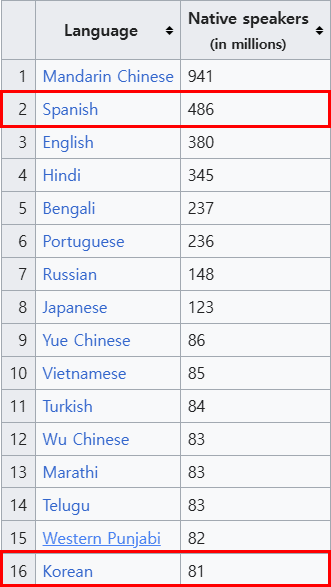
This is the classic dilemma. With 21 countries using Spanish as a primary language, their argument made sense. On the other hand, Korean is mainly spoken in Korea. From a purely practical, career-focused perspective, learning Chinese, Spanish, or English might seem like a more “useful” choice.
This post isn’t just for that Reddit user. I always ask my new students why they want to learn Korean, and I’d like to ask you the same question.
So, Why Learn Korean?
So, Is Korean a Useful Language?
Let’s address the “practical” argument first. The idea that Korean isn’t useful is outdated. The benefits of learning Korean for your career are growing every year.
Yes, it is true that Korean is not as widely spoken as Spanish or Mandarin. But is Korean a useful language? Absolutely.
- Economic Power: South Korea has the 14th largest economy in the world. It is a global leader in technology (Samsung, LG, SK), automotive (Hyundai, Kia), and engineering. Being able to speak Korean is a massive advantage in these high-stakes industries.
- Cultural Power (Hallyu): This is the game-changer. The “Korean Wave” (K-pop, K-dramas, K-beauty, K-food) is a multi-billion dollar global industry. This industry needs translators, marketers, content creators, producers, and liaisons who understand both the culture and the language. This is a very real career path.
- Diplomacy and Soft Power: South Korea’s global influence in diplomacy and culture is significant. Opportunities in government, international relations, and education are expanding.
Learning Spanish might make you one of many. Learning Korean makes you one of a few. It’s a specialized skill that can make you incredibly valuable in the right fields.
The Real Motivation to Learn Korean: Joy
All that said, when I ask my students why they learn Korean, very few mention career goals.
The most common answer is something like, “I just love Korea/Korean language/Korean culture.” For these learners, their motivation to learn Korean wasn’t a specific, practical goal. They simply encountered Korea by chance and discovered that Korean was part of what they enjoyed.
Learn Korean for K-pop and K-dramas
This is the biggest driver. But it’s not just about “liking” it. The motivation to learn Korean becomes a desire for a deeper connection.
- It’s about understanding the clever wordplay in a BTS lyric without waiting for a translation.
- It’s about catching the subtle, untranslatable nuances in a K-drama, like the difference between
밥 먹었어?(Did you eat?) and식사 하셨어요?(Have you eaten?) - It’s about laughing at a joke on a V-live in real-time with the idol.
This is a powerful, joy-based motivation that “studying for a test” can never match.
Learning for Heritage
One American student shared that her grandmother was Korean. After many lessons, I asked, “Now you can talk to your grandma in Korean, right?” She replied, “My grandmother passed away long ago.”
I was taken aback. She wasn’t learning Korean with a particular goal in mind, nor would it help her career. She simply felt a connection to the language because of her grandmother. And it was with that pure motivation to learn Korean that she found joy in the process.
Learning a Language for Academic Advancement
This contrasts sharply with my own experience. In Korea, students start learning English from elementary school and often continue studying it through college and beyond.
Yet, many Koreans still find it difficult to communicate with foreigners. I’m the same. I studied English solely for test scores and academic advancement. I didn’t realize that learning a new language could allow me to communicate with more people and enjoy more content. Instead, I focused on finding the right answers in textbooks, marking lines, and aiming for the desired score.
Speaking English fluently wasn’t my goal, so I found English incredibly boring. My motivation was external (a test), so the moment the test was over, the motivation was gone.
The Joy of Language Learning (My Story)
In college, I had the opportunity to participate in a program that connected me with Japanese and Chinese university students. We quickly became friends. Although we communicated in English, none of us were native speakers, so it was often awkward.
After the program ended, I decided to learn Chinese and Japanese. My friends didn’t understand why I was learning new languages instead of focusing on English, especially as we were nearing graduation.
But a year later, I met those friends again, and we communicated in Japanese and Chinese. That’s when I truly discovered the joy of language learning. My motivation was intrinsic—I wanted to connect with my friends. That joy made the process feel effortless.
A Final Thought: Why Learn Korean?
So, why learn Korean? If you love K-pop, K-drama, or Korean culture, then learning Korean will be a joy for you.
It’s true that learning Korean might not benefit your career as much as another language might, depending on your field. If your only goal is a career, learning a language with more global speakers could be a better choice.
But if you decide to learn Korean, it will undoubtedly deepen your enjoyment of everything Korea has to offer. And, as we’ve seen, the “impractical” choice is becoming more practical every day. The benefits of learning Korean are both professional and personal.
I hope that the “Podo Korean” app for serious learners will be a valuable resource on your Korean language journey.