I recently read an article about how international BTS fans are familiar with the cute Korean mimetic word “소복소복” (sobok sobok). This word appears in the BTS Jimin “Christmas Love” song from 2020.
In English, it was translated as “falling falling,” but I feel that this translation doesn’t quite capture the full essence of the word. What does sobok sobok mean, then? As a Korean language teacher, I found this topic fascinating.
So, in this post, I’d like to explore the meaning of sobok sobok (BTS) and other Korean repeated words that, like “소복소복,” have a cute and cozy feel.
“Christmas I love you, 흰 눈처럼 소복소복 넌 내 하루에 내려와” (Christmas I love you, like white snow, sobok sobok, you fall upon my day)
What Are Korean Onomatopoeia and Mimetic Words?
Before we analyze the list, it’s important to understand what these words are. The Korean language is full of words that describe sounds, textures, and appearances in a very vivid way.
These words are split into two groups:
- 의성어 (Ui-seong-eo) – Onomatopoeia: Words that mimic sounds.
- Example:
두근두근(dugeun dugeun) – The ‘thump-thump’ sound of a heart.
- Example:
- 의태어 (Ui-tae-eo) – Mimetic Words: Words that describe manners, appearances, or feelings.
- Example:
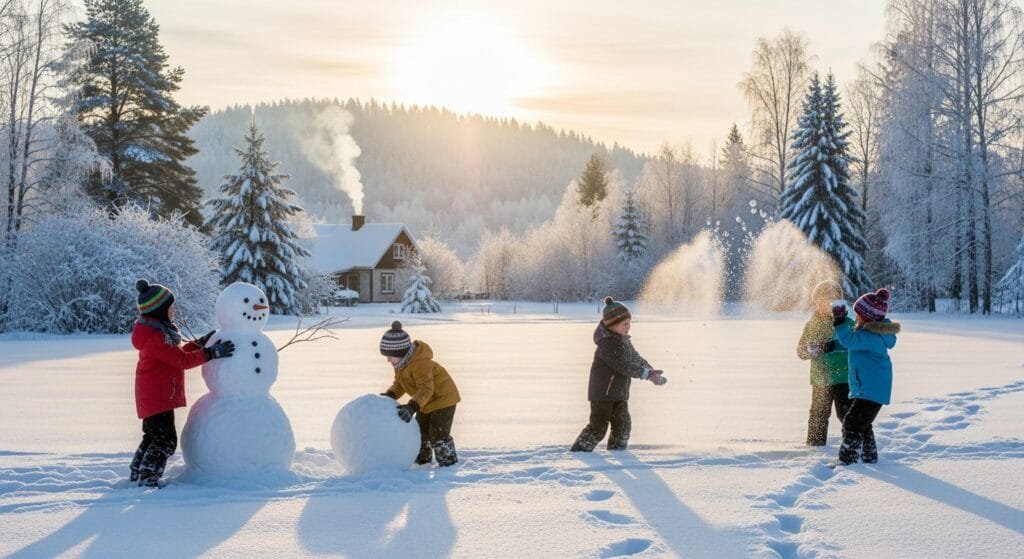
소복소복(sobok sobok) – The visual of snow piling up gently.
- Example:
Most of the cute Korean mimetic words in this post are “의태어” (ui-tae-eo).
You’ll also notice they are all Korean repeated words. This repetition is a key feature. In Korean, you can often say a word once (e.g., 소복) to mean a single instance, but repeating it (소복소복) implies the action is continuous, rhythmic, or spread over an area. This repetition is what gives these words their special descriptive power and charm.
A Guide to Cute Korean Mimetic Words
Here are some of the most common and cute Korean mimetic words you should know.
소복소복 (Sobok Sobok)
“눈이 소복소복 쌓였어요.” (The snow piled up sobok sobok.)
So, what does sobok sobok mean? The word is formed by repeating the adjective “소복하다” (sobok-hada), which describes something that is piling up softly, gently, and high.
The English translation “falling falling” in the BTS Jimin “Christmas Love” song captures the gentleness, but it misses the key nuance: piling up. “소복소복” is a visual word. It paints a picture of snow that is light, fluffy, and accumulating in a clean, pristine, and voluminous way. It implies silence and beauty. A more descriptive (but less poetic) translation would be “piling up fluffily.”
폭신폭신 (Poksin Poksin)
“침대가 폭신폭신해요.” (The bed is poksin poksin.)
This word is made by repeating the adjective “폭신하다” (poksin-hada), which describes something that is soft and springy. It’s the feeling of pressing into a high-quality cushion or a new, fluffy pillow. Like “소복소복,” it gives a sense of coziness, but with a hint of bounciness. In children’s books, it’s often used to describe clouds, inviting kids to imagine lying comfortably on them.
두근두근 (Dugeun Dugeun)
“심장이 두근두근 뛰었어요.” (My heart was dugeun dugeun.)
“두근두근” is a true onomatopoeia (의성어), created by repeating the verb “두근대다” (dugeun-daeda). It expresses the feeling of your heart pounding hard and fast, often due to surprise, anxiety, or excitement. ‘두근’ (dugeun) is the literal ‘thump’ or ‘ba-dump’ sound.
It’s the perfect word to use when you’re standing in front of a crowd for a presentation or when you’re nervous around someone you love. It’s the quintessential K-drama sound effect for a romantic moment.
반짝반짝 (Banjjak Banjjak)
“반짝반짝 작은 별” (Twinkle, twinkle, little star.)
This is one of the most common Korean mimetic words. It comes from repeating the verb “반짝이다” (banjja-gida), which describes something small and bright that appears briefly before disappearing.
While it’s famously used with stars, as in the example above, it can also describe objects that have been polished to a shine (like jewelry) or eyes filled with curiosity. It brings to mind images of brightness, purity, and a magical “sparkle.”
깜빡깜빡 (Kkamppak Kkamppak)
“단어를 자주 깜빡깜빡해요.” (I frequently kkamppak kkamppak forget words.)
This one might be a bit tricky for students who struggle with double consonants. Like “반짝반짝,” “깜빡깜빡” is based on the verb “깜빡이다” (kkamppagida), which describes a light flickering on and off.
However, it has the opposite nuance. While “반짝반짝” emphasizes the brightness, “깜빡깜빡” highlights the moments of darkness or the act of blinking.
- It’s great for describing a flickering light bulb.
- It’s used for sleepy eyes (blinking heavily).
- It’s also useful when you can’t quite remember something, as in the example above—as if your mind is “blinking” or going blank.
➤ Although this post was inspired by the sobok sobok BTS connection, you’ll find that the other Korean repeated words here are much more commonly used in daily life.
I encourage you to try using these words, keeping their nuances in mind. Learning these cute Korean mimetic words and onomatopoeia is a fantastic way to make your Korean sound more vivid and expressive. It shows you understand the feeling of the language, not just its grammar.