Hangul, the Korean writing system, is renowned for being scientific and systematic. But for many learners, figuring out how to pronounce Korean words as they are actually spoken can be a major hurdle. This is because written Korean and spoken Korean aren’t always a one-to-one match. This discrepancy is governed by a set of essential Korean pronunciation rules (phonological rules).
While there are exceptions, most cases follow a predictable pattern. Mastering these rules is the key to moving from a robotic, “textbook” accent to a more natural, fluid sound.
Today, let’s dive into one of the most common and useful pronunciation rules in Korean: consonant aspiration, specifically involving the consonant ㅎ (hieut). Understanding this single rule will instantly improve your pronunciation and listening comprehension.
Understanding Key Korean Pronunciation Rules: Aspiration
In Korean, some sounds change when they meet. This is called assimilation, and it happens to make pronunciation easier and smoother. The specific rule we are looking at today is called Korean consonant aspiration (격음화, gyeogeumhwa, or “becoming a strong sound”).
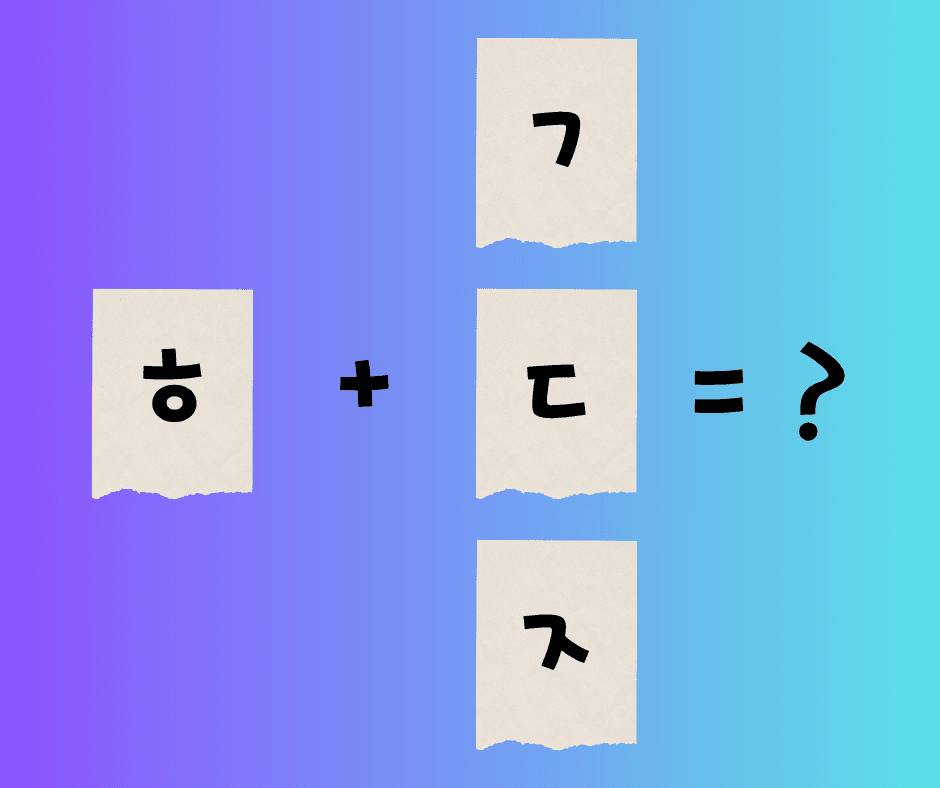
This rule applies when the final consonant ㅎ (hieut) is followed by the consonants ㄱ (giyeok), ㄷ (digeut), or ㅈ (jieut).
The sounds merge and transform into their “aspirated” counterparts: ㅋ (kieuk), ㅌ (tieut), and ㅊ (chieut), respectively.
Here’s the key point: the two sounds (e.g., ㅎ + ㄱ) don’t create two separate sounds. They combine into a single new consonant, leaving no trace of their original forms.
The ㅎ Pronunciation Rule Explained (격음화)
Let’s break down the rule with clear examples.
Rule 1: ㅎ + ㄱ → ㅋ
When ㅎ meets ㄱ, the sound changes to ㅋ (a ‘k’ sound with a stronger puff of air, like in “kite”).
- 먹히다 (to be eaten): [머키다]
- 놓고 (to put and…): [노코]
- 어떻게 (how): [어떠케]
Rule 2: ㅎ + ㄷ → ㅌ
When ㅎ meets ㄷ, it transforms into ㅌ (a ‘t’ sound with a stronger puff of air, like in “top”).
- 낳다 (to give birth): [나타]
- 좋다 (to be good): [조타]
Rule 3: ㅎ + ㅈ → ㅊ
When ㅎ meets ㅈ, the result is ㅊ (a ‘ch’ sound with a stronger puff of air, like in “church”).
- 닳지 (to wear out, and…): [탈치]
- 앉히다 (to seat someone): [안치다]
Why This Hangul Pronunciation Rule Exists (The Science)
This rule isn’t random; it highlights how scientific and systematic Hangul pronunciation really is.
Phonetically, ‘ㅎ’ is a glottal fricative. It’s basically just a puff of air made in the throat. The sounds ‘ㄱ’, ‘ㄷ’, and ‘ㅈ’ are lax or plain stops. They are made with no aspiration (puff of air).
When ‘ㅎ’ (air) meets a plain stop (no air), the ‘ㅎ’ simply adds its “air” to the next consonant.
- ㄱ (g, no air) + ㅎ (air) = ㅋ (k, with air)
- ㄷ (d, no air) + ㅎ (air) = ㅌ (t, with air)
- ㅈ (j, no air) + ㅎ (air) = ㅊ (ch, with air)
Think of ‘ㅎ’ as a power-up that makes ‘ㄱ’, ‘ㄷ’, and ‘ㅈ’ stronger. This logic is consistent and easy to apply once you recognize the pattern.
Common Mistakes to Avoid
Many learners, when they first see a word like “좋다”, try to pronounce both consonants.
Incorrect Pronunciation: [조흐다] (jo-heu-da) or [조-다] (jo-da), making the ㅎ silent.
This is the most common mistake. Remember, the two sounds merge into one. The ‘ㅎ’ isn’t pronounced separately; its property (the air) is transferred.
Correct Pronunciation: [조타] (jota)
Always look for this pattern. If you see a syllable ending in ㅎ followed by ㄱ, ㄷ, or ㅈ, you can be almost certain this aspiration rule applies. This is one of the most fundamental Korean pronunciation rules you will learn.
Practice Makes Perfect: Drill These Words
To master this rule, try saying the following words out loud. Don’t worry about their meanings at first—focus entirely on applying the ㅎ pronunciation rule.
- 놓고 (to put) → [노코] (noko)
- 많다 (to be many) → [만타] (manta)
- 좋다 (to be good) → [조타] (jota)
- 싫다 (to dislike) → [실타] (silta)
- 닿지 (to touch) → [다치] (dachi)
- 놓지 (to put) → [노치] (nochi)
- 낳다 (to give birth) → [나타] (nata)
- 낳지 (to give birth) → [나치] (nachi)
- 많고 (to be many) → [만코] (manko)
- 좋지 (to be good) → [조치] (jochi)
- 놓다 (to put) → [노타] (nota)
- 그렇게 (like that) → [그러케] (geureoke)
Beyond Aspiration: Other ㅎ Pronunciation Rules
While aspiration is the most common ㅎ pronunciation rule to encounter, ‘ㅎ’ is a bit of a chameleon. To give you a complete picture, here are two other scenarios (which we can cover in a future post!):
- When ㅎ is at the end of a word (받침): If it’s the very last sound or followed by another consonant (not ㄱ, ㄷ, ㅈ), it’s often pronounced as ㄷ. Example:
히읗→ [히읃] (hieut). - When ㅎ meets ㄴ or ㅁ: The ‘ㅎ’ sound often changes to sound like an ‘ㄴ’ (nasalization). Example:
놓는(putting) → [논는] (nonneun).
Don’t worry about these for now, but it’s good to know that Korean pronunciation rules form a complete, logical system.
Mastering This Rule: Your Next Step in Fluency
Understanding and, more importantly, using this aspiration rule is a massive step toward sounding natural. Native speakers apply these Korean pronunciation rules 100% of the time without thinking. When you start doing it too, not only will your speaking improve, but your listening comprehension will skyrocket because you’ll be able to hear [조타] and instantly recognize it as the word 좋다.
So, keep practicing! As you learn these small yet meaningful rules, you’ll uncover even more of the beauty and logic behind the Korean language. 😊