When exploring Korean traditional string instruments, two names always rise to the top: the “가야금” (Gayageum) and the “거문고” (Geomungo). At first glance, these long, zither-like instruments look quite similar. Many Koreans might even have trouble distinguishing between the two.
However, the Gayageum vs Geomungo debate is easily settled when you look closer. These two iconic instruments each boast unique charms, sounds, histories, and playing techniques.
Recently, I stumbled upon a YouTube shorts video featuring both the Gayageum and Geomungo being played together. So, today I want to provide a detailed guide on the difference between Gayageum and Geomungo, and then, we can enjoy the video I found afterward.
Gayageum vs Geomungo: A Detailed Comparison
While both are long, rectangular wooden zithers, their construction and function are fundamentally different.
Differences in Appearance (Strings, Bridges, and Frets)
The most obvious difference between Gayageum and Geomungo is the string setup.
- Gayageum: The standard Gayageum (called pungryu or beopgeum) has 12 strings. These strings (traditionally silk) rest on 12 large, movable bridges called 안족 (anjok), which look like a goose’s foot. There is also a modernized 25-string Gayageum for a wider range of sound.
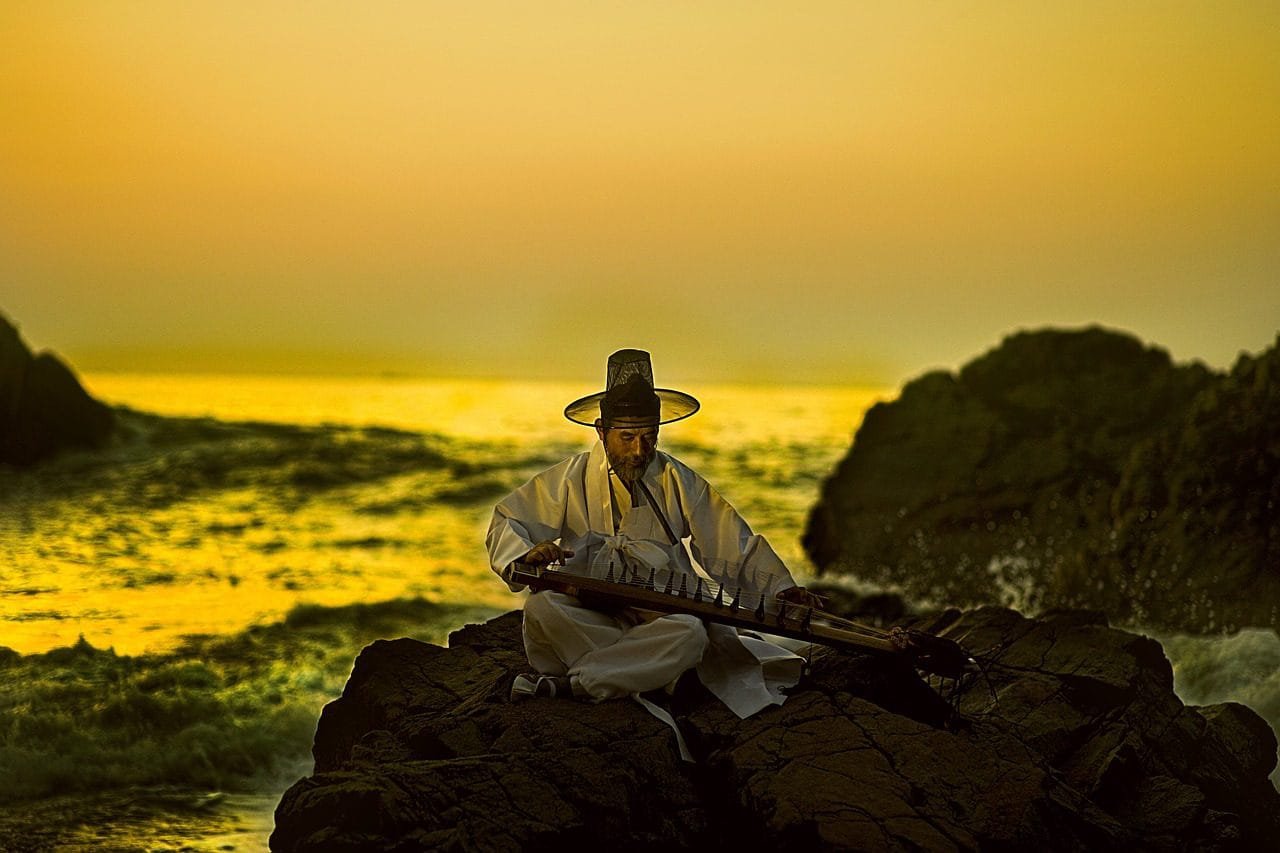
- Geomungo: The Geomungo has only 6 strings. These strings are much thicker than the Gayageum’s. More importantly, it does not use 12 movable bridges. Instead, its strings are stretched over 16 fixed frets (called 괘, gwae) and 3 smaller, movable bridges.
This is the easiest way to tell them apart: if you see a dozen large, goose-foot-shaped bridges, it’s a Gayageum. If you see frets (like on a guitar) and only 6 thick strings, it’s a Geomungo.
Differences in Playing Technique
The way the instruments are played is also a key part of the Gayageum vs Geomungo distinction.
- How to play Gayageum: The Gayageum is played by plucking and flicking the strings with the fingers of the right hand (no plectrum). The left hand is used to press the strings down to the left of the movable bridges. This pressing technique is crucial, as it allows the player to create a deep, expressive vibrato (농현, nonghyeon) and bend the pitch.
- How to play Geomungo: The Geomungo is played using a small bamboo plectrum called a “술대” (suldae), which is held between the index and middle fingers of the right hand. The player strikes the strings and the wooden soundboard with this Geomungo plectrum, creating a strong, percussive sound. The left hand presses down on the strings over the fixed frets to change the note, similar to a guitar.
Differences in Sound
Their construction and playing techniques result in vastly different sounds.
- Gayageum Sound: The Gayageum produces a bright, clear, and ornate sound. Its silk strings vibrate lightly, creating a delicate and soft tone. This makes it especially well-suited for lyrical, emotional, and fast-paced music. It’s frequently used in both traditional folk music (sanjo) and contemporary fusion music.
- Geomungo Sound: In contrast, the Geomungo has a much deeper, percussive, and resonant tone. The thicker strings and the plectrum striking the wood produce a sound that is more powerful and “masculine.” Its sound is often used to convey solemn, meditative, and tranquil moods.
The Historical and Cultural Difference Between Gayageum and Geomungo
The starkest difference between Gayageum and Geomungo may be their cultural roles.
- Gayageum’s Origin: As its name implies, the Gayageum originated in the Gaya Confederacy (가야) in the 6th century. It was developed for ensembles and folk music and was widely played by professional entertainers (gisaeng) and common people. Its sound is associated with joy, sorrow, and lyrical expression.
- Geomungo’s Origin: The Geomungo is older, dating back to the Goguryeo kingdom (4th century). Legend says it was modified from a Chinese instrument by the prime minister Wang San-ak. It was considered the “instrument of the scholar” (seonbi). Confucian scholars played the Geomungo not for an audience, but for themselves—as a form of meditation and self-cultivation. Its deep, powerful sound was thought to reflect the-mind of a disciplined gentleman.
This history led to a cultural practice where women often played the Gayageum, while men favored the Geomungo.
Conclusion: Hearing Them Together
➤ Although they may seem similar at first glance, the Gayageum vs Geomungo comparison reveals two vastly different Korean traditional string instruments. They have unique qualities in their appearance (bridges vs. frets), playing techniques (fingers vs. plectrum), and sound (bright vs. deep).
These differences contribute to the richness and diversity of Korean traditional music, and both instruments beautifully express the essence of Korean musical heritage.
Now, how about we enjoy that performance where both instruments are played together to BTS Jungkook’s “Standing Next to You”? It’s the perfect way to hear the difference between Gayageum and Geomungo in action!